

How Midnight’s Architecture Actually Works (Without the Jargon)
Most blockchains force a trade-off between transparency and privacy. Midnight was built so you no longer have to choose.

For many people, blockchain architecture feels like opening the back of a watch. Gears spin in every direction, each one essential, yet the whole mechanism can seem impossibly intricate at first glance.
Midnight is no exception. Under the hood, it relies on sophisticated cryptography and an elegantly designed proving system. But the core idea is remarkably simple: keep sensitive data private while still allowing the network to verify that everything is correct.
That balance is what makes Midnight so compelling!
The Basic Problem
Traditional public blockchains achieve trust by making information visible to everyone. Transactions, balances, and smart contract interactions can all be independently verified because they are exposed on a shared ledger.
That transparency is powerful for trust but it comes at a cost. For many real-world applications especially in business and finance visible information can put these systems at risk and cause trouble by giving out sensitive data to the wrong crowd.
Private systems solve this by hiding information. The catch is that they often reintroduce trust. Instead of trusting code and mathematics, you are asked to trust administrators, intermediaries, or a limited group of participants.
Midnight was designed to avoid both extremes.
Two States, Working Together
At the heart of Midnight is a simple but powerful idea: separate what must be public from what should remain private. There is a public state, which lives on-chain and is visible to everyone. This includes the information the network needs to reach consensus, such as transaction proofs, smart contract commitments, and any data intentionally made public.
Alongside it sits a private state, which remains entirely under the user’s control. It is stored locally on the user’s device and is never published to the blockchain unless the user explicitly chooses to disclose something. This dual-state model is enabled by Midnight’s underlying proving architecture, known as Kachina, which coordinates the relationship between public and private state.
Think of it as keeping the recipe in your own kitchen while only serving the finished dish. The blockchain does not need every ingredient. It only needs proof that the meal was prepared correctly.
The Bridge: Zero-Knowledge Proofs
This is where the real magic happens, though it is really just very clever mathematics. A zero-knowledge proof allows you to prove that something is true without revealing the information that makes it true.
You can prove you are over eighteen without revealing your exact birthdate. You can prove you have sufficient funds without exposing your account balance. You can prove a transaction follows the rules without disclosing every detail inside it.
Under the hood, Midnight uses zk-SNARKs: zero-knowledge proofs that are both succinct and non-interactive. In plain English, that means the proofs are compact, efficient to verify, and do not require an ongoing back-and-forth between the prover and the network.
On Midnight, computations happen privately on your device. Once complete, your device generates a cryptographic proof. The network verifies that proof and accepts the result, all without ever seeing the underlying private data.
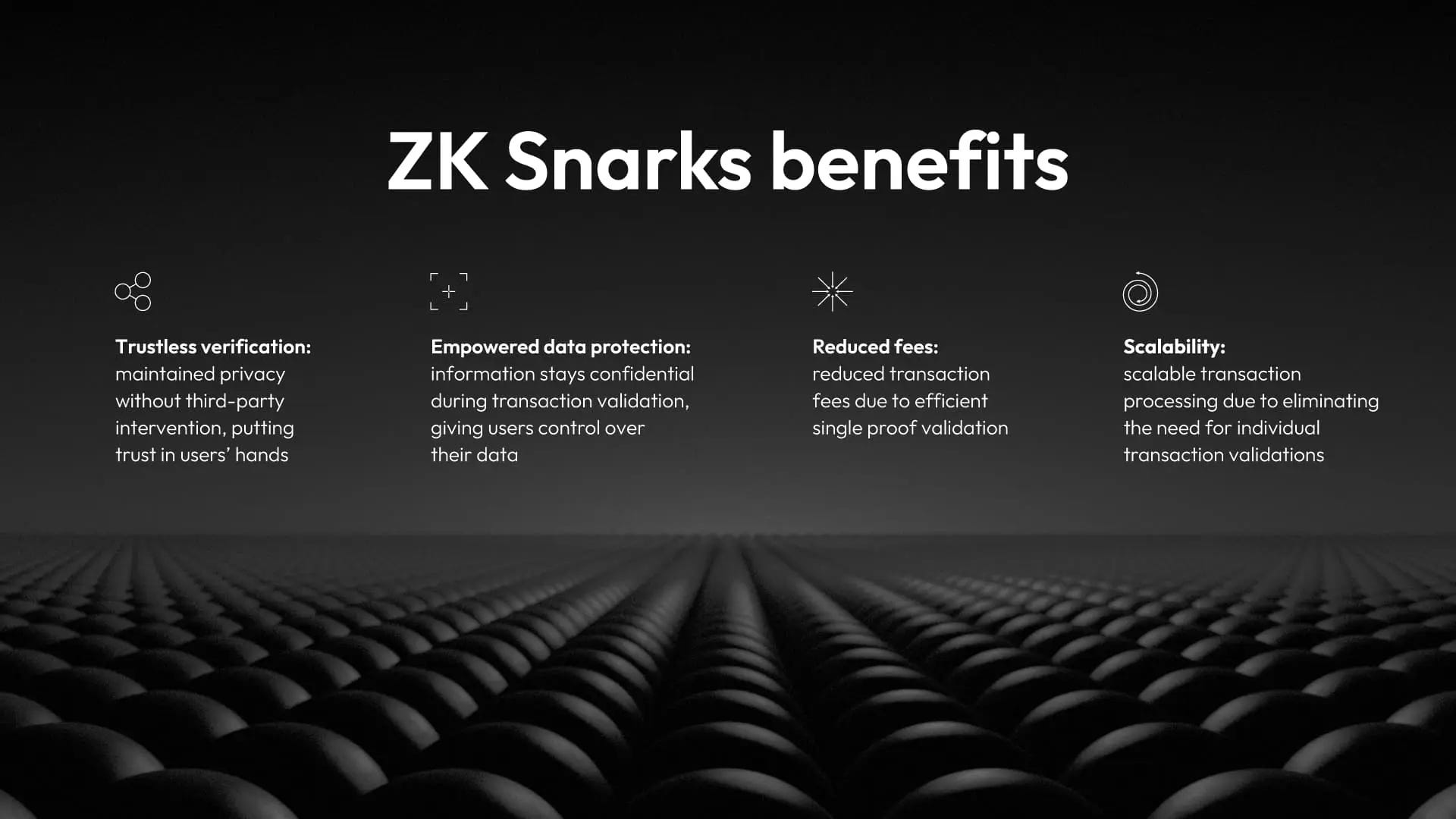
In other words, Midnight verifies outcomes, not secrets.
Why This Matters
This architecture rewrites one of blockchain’s oldest trade-offs. Instead of forcing a choice between privacy and verification, Midnight separates the two. Sensitive information remains private, while the network still gets the assurance it needs.
That opens the door to applications that were previously difficult, or simply impossible, on traditional blockchains. Private payments, confidential business workflows, identity systems, and regulated financial products all become far more practical.
Built for Developers Too
Historically, building with zero-knowledge cryptography required highly specialized expertise. It was extraordinarily powerful, but hardly accessible. Midnight lowers that barrier through its programming language, Compact. With syntax that feels familiar to TypeScript developers, Compact automatically compiles application logic into zero-knowledge circuits behind the scenes.
That means developers can focus on building useful applications instead of becoming cryptographers first. Just as importantly, privacy is the default. Any information that should be revealed must be explicitly declared, giving developers precise control over disclosure.
A Simple Mental Model
Most blockchains are like a glass house. Everyone can see inside, which makes trust easy, but privacy almost impossible. Traditional private systems are more like a locked warehouse. Privacy is strong, but you have to trust whoever holds the keys.
Midnight is different. It is more like a secure vault with a viewing window, one that reveals only exactly what you choose to show. You can verify what matters without exposing everything else.
Final Thought
Midnight’s architecture is not about making blockchains less transparent or more secretive. It is about making them more precise. The goal is simple: reveal only what needs to be known, prove what needs to be proven, and keep everything else under your control.
Midnight doesn’t just make privacy possible, it makes privacy programmable. That is what makes it feel less like a compromise and more like the next evolution of blockchain design.
If this helped demystify how Midnight works, subscribe for more plain-English breakdowns of Midnight, Cardano, and the future of privacy-first crypto.